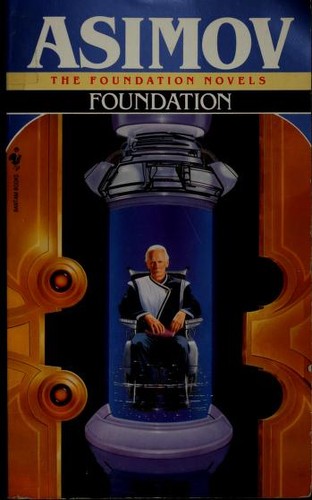
Foundation
"Never let your sense of morals prevent you from doing what is right."
Mathematician Hari Seldon develops psychohistory—a science that can predict the future—and discovers the Galactic Empire will collapse, plunging humanity into 30,000 years of darkness. He establishes the Foundation on a remote planet to reduce this dark age to just 1,000 years. The novel follows the Foundation's efforts to preserve knowledge and guide civilization through the coming darkness.
Foundation established the template for epic science fiction and introduced the concept of psychohistory, blending mathematics with narrative to explore how civilizations evolve. Asimov's exploration of reason, logic, and long-term planning became foundational to the genre and influenced generations of writers. It won the Hugo Award for Best All-Time Series in 1966.
- Reason and rationality are driving forces behind human progress and societal stability
- Long-term planning and prediction of historical patterns can guide civilization through crisis
- Knowledge and education are humanity's greatest weapons against ignorance and barbarism
- Individual improvisation is as important as careful planning in navigating complex systems
- Heavy emphasis on dialogue and exposition over action makes it slow-paced for modern readers
- Female characters are largely absent, reflecting the limitations of 1950s science fiction writing
"Nominated as one of America's best-loved novels"
PBS, The Great American Read"Won the Hugo Award for Best All-Time Series in 1966"
The Foundation Trilogy, Hugo Award Committee