10 Essential Game Design Books

Foundational Texts for Aspiring and Professional Game Designers

These ten books represent the most influential and essential works in game design, covering everything from fundamental mechanics and player psychology to spatial design and virtual world building. Whether you're designing board games, video games, or interactive experiences, these texts provide the theoretical frameworks and practical wisdom that have shaped the modern gaming industry.

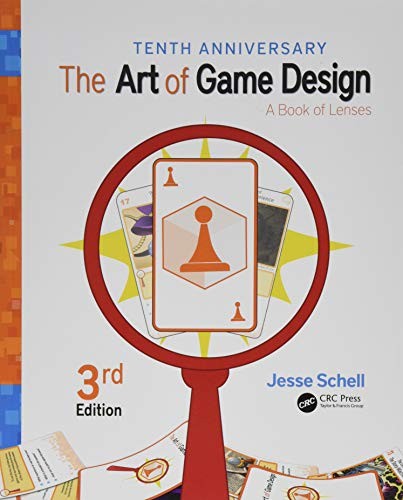
The Art of Game Design: A Book of Lenses
01

The Art of Game Design: A Book of Lenses

by Jesse Schell

"Good game design happens when you view your game from as many perspectives as possible."

A comprehensive guide offering over 100 lenses—different perspectives and questions—for analyzing and improving game design. Schell combines insights from psychology, architecture, music, film, and other disciplines to help designers view their work from multiple angles. The third edition includes examples from VR, AR, and modern games.

Widely considered the Bible of game design, this book is essential for understanding how to approach design problems systematically. Schell's lens-based methodology has become a standard teaching tool in universities and studios worldwide. It covers the entire game development process from conceptualization to player experience.

  • Use multiple lenses to analyze and improve your game design from different perspectives
  • Understand the fundamental principles of fun, player psychology, and engagement mechanics
  • Apply cross-disciplinary insights from psychology, architecture, and other fields to game design
  • Balance multiple design priorities simultaneously to create compelling player experiences
  • The breadth of topics may feel overwhelming for beginners; some sections lack depth
  • The lens-based approach is effective but abstract, requiring strong design intuition to apply

"Easily the most comprehensive, practical book I've ever seen on game design."

Will Wright, Designer of SimCity and The Sims

"Everyone in the game industry should have this book. It's the best resource available."

Erin Hoffman, Senior Game Producer, ArenaNet
Rules of Play: Game Design Fundamentals
02

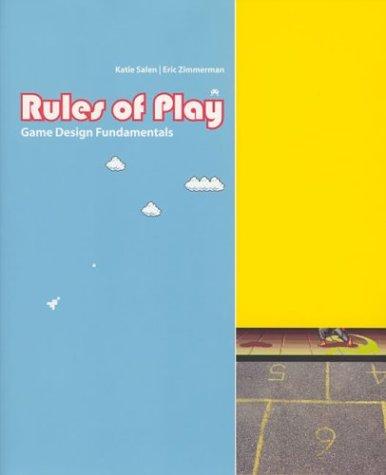
Rules of Play: Game Design Fundamentals

by Katie Salen Tekinbaş and Eric Zimmerman

"A game is a system in which players engage in artificial conflict, defined by rules, that results in a quantifiable outcome."

A comprehensive textbook and theoretical framework for understanding games as systems. Salen and Zimmerman present 18 game design schemas covering games as systems of emergence, contexts for social play, storytelling media, and cultural practices. The book unifies video games, board games, sports, and other interactive experiences under one coherent design philosophy.

This foundational text established game design as an academic discipline and is used in game design courses worldwide. It provides a rigorous theoretical foundation that bridges game criticism, design practice, and technical research. The book's systematic approach to defining play, design, and interactivity has influenced an entire generation of designers.

  • Understand games as systems with defined rules, play, and meaningful player agency
  • Apply 18 conceptual frameworks to analyze games from multiple theoretical perspectives
  • Recognize how emergence and interactivity create meaningful gameplay experiences
  • Use formalist design schemas to develop more sophisticated and intentional game design
  • The book is dense and academic, making it challenging for beginners without design background
  • Heavy focus on theory over practical implementation can feel disconnected from actual design work

"The most impressive book on game design I've ever seen. Broad in scope yet rich in detail, Rules of Play sets a new standard for game analysis."

Will Wright, Game Designer of Sim City and The Sims

"Salen and Zimmerman do for games what Sergei Eisenstein did for cinema—offer an expert practitioner's perspective on central aspects of the aesthetics and cultural importance of an emerging medium."

Henry Jenkins, Director of Comparative Media Studies at MIT

"Rules of Play makes a monumental contribution to the development of game theory, criticism, and design."

Nathan Shedroff, Author of Experience Design
A Theory of Fun for Game Design
03

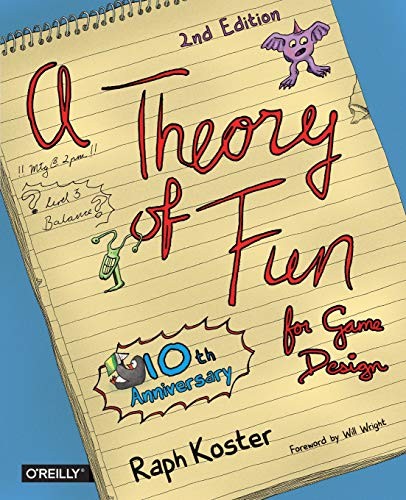
A Theory of Fun for Game Design

by Raph Koster

"That's what games are, in the end. Teachers. Fun is just another word for learning."

An illustrated exploration of what makes games fun, arguing that all games are fundamentally about learning and pattern recognition. Koster examines how players master patterns, and why games cease to be fun when players have exhausted all challenges. The book connects game design to neuroscience, education, and human psychology.

Koster's core thesis that fun equals learning has become foundational to game design thinking. As a veteran designer of Ultima Online and Star Wars Galaxies, Koster brings genuine industry experience. The book's illustrated format and accessible writing make complex design concepts understandable to designers at all levels.

  • Understand fun as learning new patterns and mastering challenges through gameplay
  • Design progression systems that continuously introduce new patterns and learning opportunities
  • Recognize that player engagement decreases when pattern mastery is complete without new challenges
  • Apply learning psychology principles to create more engaging and rewarding game experiences
  • The argument that all fun reduces to pattern learning oversimplifies complex player motivations
  • Some endorsements on the book lack depth and appear generic

"Does for games what Understanding Comics did for sequential art. You'll never look at fun the same way again."

Cory Doctorow, Author and Technology Activist

"Raph Koster offers a road map for how to make games an even more expressive medium."

Henry Jenkins, Director of MIT Comparative Media Studies
Game Design Workshop: A Playcentric Approach to Creating Innovative Games
04

Game Design Workshop: A Playcentric Approach to Creating Innovative Games

by Tracy Fullerton

"The playcentric approach puts the player experience at the center of every design decision from beginning to end."

A practical, hands-on guide emphasizing player experience throughout the design process. Fullerton provides concrete tools for prototyping, playtesting, and iterating games, with emphasis on empathy for the player. The book includes numerous exercises and case studies demonstrating how theory connects to actual game development practice.

This is widely used as the standard textbook for game design education and is considered essential reading for professionals. Fullerton's playcentric approach balances theory with actionable methodology. The exercises teach practical skills that can be applied immediately to real design projects.

  • Adopt a playcentric design philosophy that prioritizes player experience in every decision
  • Master playtesting and iteration techniques to continuously improve your game designs
  • Use prototyping to explore and validate design ideas quickly and efficiently
  • Balance formal design theory with practical, hands-on development methodology
  • The emphasis on playcentric design may undervalue other important considerations like narrative or aesthetics
  • Some exercises and examples may feel dated as game design practices evolve

"The gold standard game design teaching text. Required reading for professionals."

Brenda Romero, Studio Director of Romero Games

"This book fundamentally transformed my perspective on games. An essential resource for all aspiring game designers."

Jenova Chen, CEO and Creative Director of thatgamecompany

"The voices of an inclusive range of design experts makes Game Design Workshop not only an invaluable guide to making games, but a contemporary portrait of the creative field."

Naomi Clark, Chair of NYU Game Center
Level Up! The Guide to Great Video Game Design
05

Level Up! The Guide to Great Video Game Design

by Scott Rogers

"Great game design is about creating an experience that makes the player feel something—whether it's joy, frustration, fear, or triumph."

A conversational, practical guide written by a veteran game designer with credits on Pac-Man World, God of War, and SpongeBob SquarePants. Rogers covers everything from initial concept development to level design specifics, camera systems, user interfaces, and the business side of game design. The writing style is friendly and accessible, making complex concepts easy to understand.

Rogers brings decades of professional experience and writes in an approachable, mentor-like tone. Unlike purely theoretical texts, this book focuses on practical advice that designers can immediately apply. It's invaluable for understanding the nuts and bolts of professional game development.

  • Master practical level design techniques including layout, pacing, and environmental storytelling
  • Understand camera systems, controls, and user interfaces from a player-centric perspective
  • Apply professional production practices and workflows to your game development
  • Balance creative vision with technical constraints and business requirements
  • Some advice reflects specific technologies and design practices that may become outdated
  • The breadth of topics means individual subjects receive less depth than specialized books

"Scott Rogers has written the perfect book for anyone wanting to understand game design from a professional perspective."

Mark Cerny, Console Architect, PlayStation

"This book is packed with practical wisdom from someone who has shipped real games."

Tim Schafer, President of Double Fine Productions
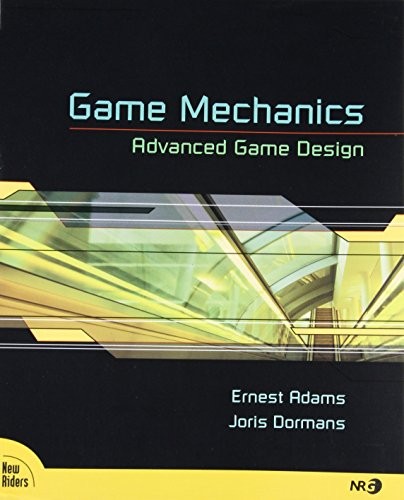
Game Mechanics: Advanced Game Design
06

Game Mechanics: Advanced Game Design

by Ernest W. Adams and Joris Dormans

"Mechanics are the base components of the game—the rules, basic actions players can take, and the algorithms that govern how the game world responds."

An advanced treatment of game mechanics that introduces the Machinations framework for visualizing and simulating game systems. Adams and Dormans show how to design, balance, and iterate mechanics using formal methods and visual design patterns. The book includes a free simulation tool for testing mechanics without building full game prototypes.

This is the only comprehensive book dedicated specifically to game mechanics as a formal discipline. It provides essential tools for designing and balancing complex mechanical systems. The Machinations framework has become influential in both academic and professional game development.

  • Use the Machinations framework to visualize and test game mechanics before implementation
  • Understand emergence and how simple mechanics create complex, engaging gameplay
  • Apply design patterns and simulation techniques to balance game systems effectively
  • Think systematically about how mechanics interact to create meaningful gameplay dynamics
  • The formal approach requires significant design literacy and abstract thinking
  • The Machinations tool has a learning curve and may be intimidating for beginners

"I've been waiting for a book like this for ten years: packed with game design goodness that tackles the science without undermining the art."

Richard Bartle, Co-author of the first MMORPG, University of Essex

"Essential reading for anyone serious about game design."

Kellee Santiago, Creative Director, thatgamecompany
Designing Virtual Worlds
07

Designing Virtual Worlds

by Richard A. Bartle

"The purpose of a virtual world is to be a place where the player can explore a version of themselves."

A comprehensive guide to creating virtual worlds and MMOs, written by the co-creator of the first MMORPG. Bartle covers worldbuilding, player motivation, social dynamics, economics, and immersion. The second edition updates the original with modern examples and explores how player psychology and virtual economies function in persistent online worlds.

Bartle's foundational taxonomy of player types and his insights into virtual world design are essential for anyone designing multiplayer or persistent games. As a pioneering designer, he brings unique perspective on how virtual worlds function as social spaces. The book covers both technical and human factors critical to online game success.

  • Understand player motivations through the Bartle taxonomy of player types and preferences
  • Design virtual economies and progression systems that sustain long-term player engagement
  • Create world design that supports diverse playstyles and social interactions
  • Balance technical systems with human psychology to build thriving online communities
  • Heavy focus on MMOs makes the book less relevant to single-player or non-persistent game design
  • Some concepts and examples reflect older MMO design paradigms that have evolved

"The second edition is equally important as the first, updating the text for the modern day and bringing fresh insight. It is an indispensable text for understanding the what, why, and how of online worlds."

Raph Koster, Designer of Ultima Online and Star Wars Galaxies

"It is impossible to understand the origins of today's fully immersive online existence without reflecting on Richard Bartle's achievements."

Edward Castronova, Professor of Media, Indiana University
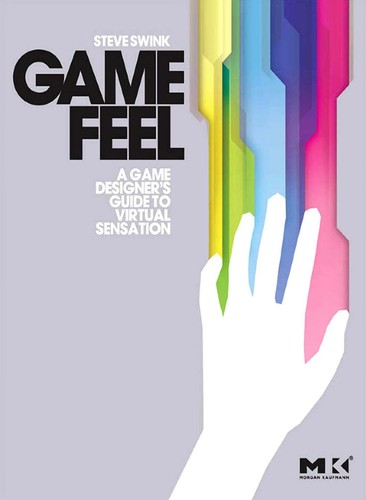
Game Feel: A Game Designer's Guide to Virtual Sensation
08

Game Feel: A Game Designer's Guide to Virtual Sensation

by Steve Swink

"Game feel is realtime control of virtual objects in a simulated space, with interactions emphasised by polish—the aesthetic sensation of control."

An exploration of how player control and interaction create the subjective sense of quality in games. Swink analyzes the relationship between input, feedback, and player perception, covering sound design, visual feedback, timing, and metaphor. The book is illustrated and includes concrete frameworks for understanding and improving the feel of player interactions.

Game feel is often overlooked but critical to player satisfaction. Swink is the first to systematically address this hidden language of game design. Understanding feel is essential for creating games that feel responsive and satisfying to play. The concepts apply across all game genres.

  • Understand how input delay, audio feedback, and visual polish create player satisfaction
  • Design responsive controls and feedback systems that give players a sense of direct agency
  • Apply the components of game feel systematically to improve overall player experience
  • Use sound, animation timing, and visual effects to enhance the sensation of interaction
  • The subjective nature of feel makes some recommendations difficult to apply universally
  • The book emphasizes implementation details that require hands-on experience to fully understand

"Steve Swink has written the definitive work on what makes games feel good to play."

Cliff Bleszinski, Lead Designer of Gears of War

"Essential reading for understanding the craft of game design."

Jonathan Blow, Designer of Braid and The Witness
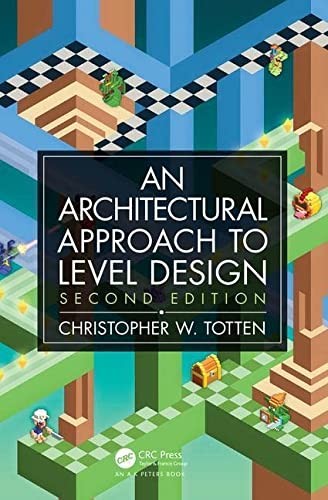
An Architectural Approach to Level Design
09

An Architectural Approach to Level Design

by Christopher W. Totten

"Level design is architecture for the player to explore, and every architectural choice communicates meaning and guides the player's experience."

The first comprehensive integration of architectural and spatial design theory with game level design. Totten, trained in both architecture and game design, demonstrates how architectural principles guide player experience through space. The second edition expands coverage to 3D, multiplayer, and modern game engines while maintaining focus on how space shapes player emotion and action.

This book bridges two disciplines, providing game designers with architectural vocabulary and methodology they can use to create more sophisticated spaces. Understanding spatial design principles helps designers move beyond intuitive design toward deliberate, intentional use of space to guide and influence player experience.

  • Apply architectural principles like symmetry, balance, and proportion to create engaging game spaces
  • Use spatial hierarchy and circulation design to guide player movement and attention
  • Understand how different space types and proportions evoke specific emotions and encourage certain actions
  • Design multiplayer spaces that support different playstyles and strategic approaches
  • The architectural focus may oversimplify level design, which involves gameplay mechanics and narrative
  • Some architectural concepts require background knowledge to fully appreciate

"This book fundamentally changed how I approach level design, giving me a language for intentional spatial design."

Naoki Sakai, Senior Level Designer, FromSoftware

"Christopher Totten has created an invaluable resource for understanding how space communicates in games."

Steve Gaynor, Creative Director of Fullbright Company
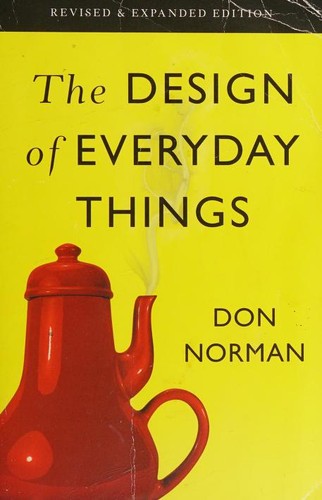
The Design of Everyday Things: Revised and Expanded Edition
10

The Design of Everyday Things: Revised and Expanded Edition

by Don Norman

"The fault lies not in ourselves, but in design that ignores the needs and psychology of people."

While not specifically about games, this foundational text on user-centered design and cognitive psychology is widely recommended by game designers. Norman explains how good design makes things intuitive and usable, covering principles like affordances, feedback, constraints, and mental models. The revised edition updates examples and expands coverage of modern design challenges.

Game designers frequently cite this as the most valuable non-game book for understanding design. Norman's principles of making things visible, exploiting natural relationships, and using constraints directly apply to interface design, control schemes, and user experience in games. It provides essential context for understanding why some game designs work intuitively while others confuse players.

  • Apply user-centered design principles to create intuitive game interfaces and control systems
  • Understand cognitive psychology concepts that explain player confusion and frustration
  • Use affordances and constraints to guide player behavior without explicit instruction
  • Design for error by anticipating player mistakes and providing helpful feedback
  • The book focuses on everyday objects rather than games, requiring translational thinking
  • Some examples are dated, though the core principles remain timeless

"Don Norman's principles are essential reading for any game designer serious about creating engaging experiences."

Jane McGonigal, Game Designer and Researcher, Institute for the Future

"This book teaches the fundamentals of good design that every game designer should understand."

Ethan Nicholas, Lead Programmer, Epic Games
Back to all lists