The Leadership Library: 10 Books Every Leader Must Read

Timeless principles and modern frameworks for leading teams, organizations, and yourself

Leadership is not a title or a position—it is a practice, refined through study, reflection, and deliberate action. The ten books assembled here represent the most influential and enduring works on the subject, spanning strategic vision, team dynamics, personal effectiveness, motivation, and the courage required to lead authentically. From boardrooms to battlefields, from Fortune 500 companies to nuclear submarines, these authors have distilled decades of research and lived experience into frameworks that have shaped how millions of people think about influence, accountability, and purpose.

01

Good to Great: Why Some Companies Make the Leap...and Others Don't

by Jim Collins

View on Amazon →

"Good is the enemy of great. And that is one of the key reasons why we have so little that becomes great."

Drawing on a rigorous five-year research project, Collins identifies the key factors that enable companies to transition from merely good performance to sustained greatness. The book introduces foundational concepts including Level 5 Leadership, the Hedgehog Concept, and the Flywheel Effect that have become standard vocabulary in business strategy.

Good to Great is the most data-driven leadership book ever written, analyzing 1,435 companies over 40 years to isolate what separates enduring excellence from mediocrity. Its finding that the best leaders combine personal humility with fierce professional resolve has fundamentally reshaped how organizations identify and develop leadership talent.

  • Level 5 leaders channel ambition toward the organization rather than themselves, combining humility with unwavering professional will.
  • Get the right people on the bus before deciding where to drive it—who comes before what.
  • Confront the brutal facts of your current reality while maintaining absolute faith that you will prevail in the end.
  • Sustained greatness comes from consistent effort in a single direction, not from dramatic transformation programs.
  • Several of the 'great' companies identified in the study, such as Fannie Mae and Circuit City, later collapsed—raising questions about the durability of the findings.
  • The methodology relies on retrospective pattern-matching, which critics argue can produce narratives that feel compelling but lack predictive power.
  • The book focuses almost exclusively on large corporations, limiting its applicability to startups, nonprofits, and other organizational contexts.

"Jim Collins is the most important management thinker of his generation."

Peter Drucker, Management scholar and author

"Good to Great is the most rigorously researched management book I have ever read."

Marc Andreessen, Co-founder, Andreessen Horowitz
02

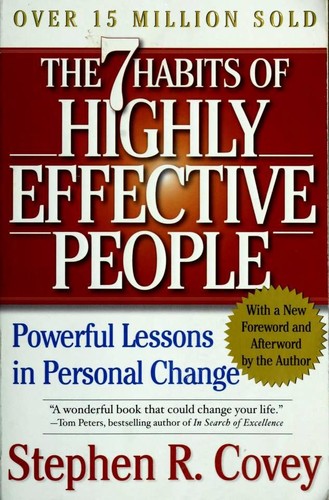
The 7 Habits of Highly Effective People: Powerful Lessons in Personal Change

by Stephen R. Covey

View on Amazon →

"Most people do not listen with the intent to understand; they listen with the intent to reply."

Covey presents a principle-centered approach to personal and professional effectiveness built around seven sequential habits that move individuals from dependence to independence to interdependence. The framework integrates character ethics with practical time management, communication, and collaboration strategies.

With over 40 million copies sold and named the #1 Most Influential Business Book of the Twentieth Century, this is the foundational text on personal leadership. Covey's insight that effective leadership begins with self-mastery—before one can lead others, one must lead oneself—remains the bedrock of virtually every leadership development program worldwide.

  • Be proactive: focus your energy on what you can control rather than reacting to external circumstances.
  • Begin with the end in mind—define your personal mission and values before making daily decisions.
  • Seek first to understand, then to be understood: empathic listening is the foundation of influence.
  • Think win-win in all interactions; sustainable leadership requires outcomes where all parties benefit.
  • The book's tone can feel prescriptive and moralistic, drawing heavily on Covey's personal faith tradition in ways that may not resonate with all readers.
  • Critics argue the habits are broad principles rather than actionable techniques, making implementation challenging without additional frameworks.
  • Some reviewers find the writing repetitive, with concepts restated across multiple chapters without sufficient new depth.

"I've never known any teacher or mentor on improving personal effectiveness to generate such an overwhelmingly positive reaction."

John Pepper, Former President, Procter & Gamble

"This book contains the kind of penetrating truth about human nature that is usually found only in fiction."

Orson Scott Card, Author of Ender's Game
03

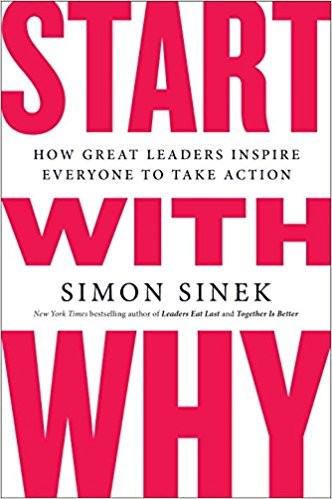
Start with Why: How Great Leaders Inspire Everyone to Take Action

by Simon Sinek

View on Amazon →

"People don't buy what you do; they buy why you do it. And what you do simply proves what you believe."

Sinek introduces the Golden Circle framework—Why, How, What—arguing that the most inspiring leaders and organizations communicate from the inside out, starting with purpose rather than product. Drawing on examples from Apple to Martin Luther King Jr., the book makes the case that people don't buy what you do, they buy why you do it.

Start with Why has become the definitive text on purpose-driven leadership, with Sinek's corresponding TED Talk ranking as the third most-watched in history. The book provides a simple but powerful framework for aligning teams, building loyalty, and making decisions that are rooted in organizational identity rather than short-term tactics.

  • Every organization knows what they do; great organizations start by articulating why they exist.
  • Inspiration, not manipulation, creates lasting loyalty among customers and employees alike.
  • The Golden Circle aligns biology with leadership: the 'why' speaks to the limbic brain, which drives decision-making and loyalty.
  • Leaders who communicate purpose attract followers who share their beliefs, creating movements rather than transactions.
  • The book relies heavily on a small number of examples—particularly Apple—and critics argue the framework is less universally applicable than presented.
  • Academics have noted that the Golden Circle model oversimplifies organizational behavior and lacks rigorous empirical validation.
  • The core message could be conveyed in a long essay; many reviewers find the book repetitive across its chapters.

"A powerful and penetrating exploration of what separates great companies and great leaders from the rest."

Polly LaBarre, Coauthor of Mavericks at Work

"Start with Why is a must-read for anyone who wants to inspire others or be inspired."

Howard Schultz, Former CEO, Starbucks
04

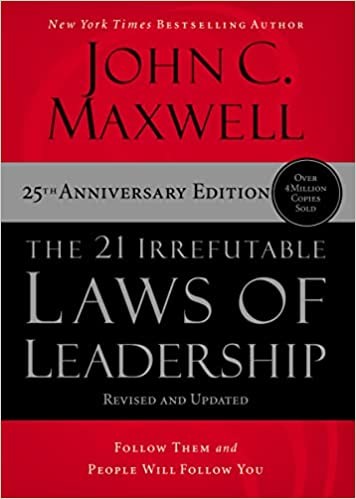
The 21 Irrefutable Laws of Leadership: Follow Them and People Will Follow You

by John C. Maxwell

View on Amazon →

"The true measure of leadership is influence—nothing more, nothing less."

Maxwell distills over three decades of leadership experience into 21 fundamental laws, each illustrated with stories from business, politics, sports, and military history. The book operates on the premise that leadership ability determines a person's level of effectiveness, and that these laws can be learned and practiced by anyone.

John Maxwell is the world's most widely read leadership author, and this book is his magnum opus. Its law-by-law structure provides an accessible diagnostic tool for leaders at every level to identify their strengths and gaps, making it both a foundational primer and an ongoing reference for leadership development.

  • Leadership is influence: your ability to lead is capped by your ability to influence others, regardless of your title.
  • The Law of the Lid means your leadership ability determines your effectiveness ceiling—invest in growing it continuously.
  • Leaders add value by serving others; the bottom line is how far you advance the people around you.
  • Trust is the foundation of leadership; it is built through consistent character, competence, and connection.
  • The 'irrefutable' framing has been criticized as overly absolute—leadership is highly contextual and resists universal laws.
  • Some of the historical anecdotes are simplified or lack nuance, serving the narrative at the expense of accuracy.
  • The book can feel like a collection of motivational talks rather than a cohesive theory, with limited empirical backing for its claims.

"Our nation and its institutions are crying out for leaders. John Maxwell shows us the true path to leadership through the application of timeless principles supported by the bedrock of personal character."

Edward C. Emma, President & COO, Jockey International

"Maxwell has done a great service to all of us by writing this book. His laws are practical, insightful, and deeply rooted in timeless principles."

Stephen R. Covey, Author of The 7 Habits of Highly Effective People
05

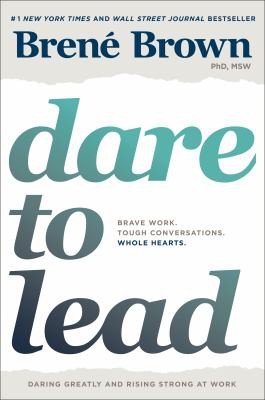
Dare to Lead: Brave Work. Tough Conversations. Whole Hearts.

by Brené Brown

View on Amazon →

"Vulnerability is not winning or losing. It's having the courage to show up when you can't control the outcome."

Brown applies her groundbreaking research on vulnerability, courage, and shame to the workplace, arguing that daring leadership requires the willingness to show up when you can't control the outcome. The book provides concrete tools for building brave cultures, having tough conversations, and leading with empathy without sacrificing accountability.

Dare to Lead brought emotional intelligence and vulnerability into the mainstream leadership conversation in a way no previous book had achieved. Brown's research-backed framework gives leaders permission to be human while providing structured practices—like rumbling with vulnerability and operationalizing values—that translate directly into organizational culture change.

  • Courage and vulnerability are inseparable—you cannot have one without practicing the other.
  • Clear is kind; unclear is unkind. Leaders must prioritize direct, honest communication even when it's uncomfortable.
  • Operationalize your values by defining two or three core values and identifying specific behaviors that support them.
  • Trust is built in small moments, not grand gestures—the acronym BRAVING breaks trust into measurable components.
  • Some business leaders find the emphasis on vulnerability at odds with high-performance cultures that demand toughness and resilience.
  • The book draws primarily on qualitative research and personal narrative, which critics argue lacks the rigor of quantitative organizational studies.
  • Readers already familiar with Brown's earlier works may find significant overlap in the core concepts presented here.

"This book is a road map for anyone who wants to lead mindfully, live bravely, and dare to lead."

Sheryl Sandberg, Former COO, Meta (Facebook)

"Dare to Lead will challenge everything you think you know about brave leadership and give you honest, straightforward, actionable tools for choosing courage over comfort."

Tarana Burke, Founder, Me Too movement
06

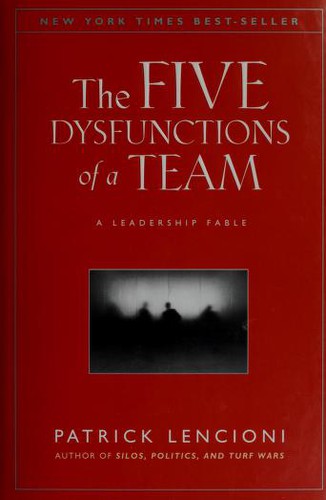
The Five Dysfunctions of a Team: A Leadership Fable

by Patrick Lencioni

View on Amazon →

"Not finance. Not strategy. Not technology. It is teamwork that remains the ultimate competitive advantage, both because it is so powerful and so rare."

Presented as a leadership fable, Lencioni identifies five interconnected dysfunctions that undermine team performance: absence of trust, fear of conflict, lack of commitment, avoidance of accountability, and inattention to results. The narrative format makes complex team dynamics accessible while the accompanying model provides a diagnostic framework for any team.

With over three million copies sold, this is the most widely used team leadership framework in the world. Its pyramid model gives leaders a clear, sequential roadmap for building high-performing teams—starting with trust and building upward. Nearly every executive team-building program references Lencioni's five dysfunctions as the starting diagnostic.

  • Trust is the foundation of effective teamwork; without vulnerability-based trust, teams cannot engage in honest dialogue.
  • Healthy conflict—productive, ideological debate around ideas—is essential and should not be confused with personal attacks.
  • Commitment requires clarity and buy-in, not consensus; leaders must drive decisions forward even without unanimous agreement.
  • Peer-to-peer accountability is more effective than top-down enforcement; teams must hold each other to high standards.
  • The fable format, while engaging, sacrifices depth—the fictional scenario can feel overly simplified compared to real organizational complexity.
  • The model presents the five dysfunctions as a neat hierarchy, but critics note that real team problems are often messier and more interrelated.
  • The book offers limited guidance on implementation in large, distributed, or cross-functional organizations.

"The Five Dysfunctions of a Team has stood the test of time, because practicing leaders—those who must get things done through the power of teams—find its insights timeless, incisive, and useful."

Jim Collins, Author of Good to Great

"Pat Lencioni has captured the essence of what makes teams effective and what makes them dysfunctional."

Ken Blanchard, Coauthor of The One Minute Manager
07

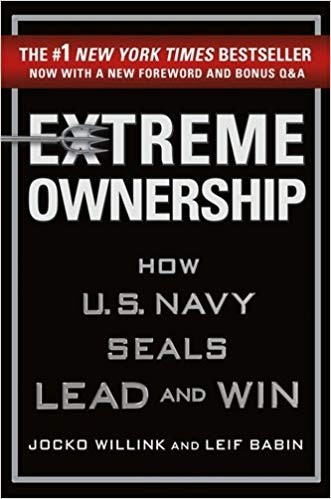
Extreme Ownership: How U.S. Navy SEALs Lead and Win

by Jocko Willink & Leif Babin

View on Amazon →

"The leader is truly and ultimately responsible for everything. That is Extreme Ownership."

Drawing from their combat experience leading SEAL Task Unit Bruiser in the Battle of Ramadi, Willink and Babin translate battlefield leadership principles into a framework applicable to any organization. The central thesis is that leaders must own everything in their world—there is no one else to blame.

Extreme Ownership provides the most uncompromising treatment of personal accountability in the leadership canon. Its combat-to-boardroom structure makes abstract concepts visceral and memorable, and the core principle—that a leader who takes complete ownership of failure creates a culture where everyone else does the same—has become a defining framework for leadership responsibility.

  • Leaders must own everything in their world—if a team fails, the leader is responsible, full stop.
  • There are no bad teams, only bad leaders; leadership is the single greatest factor in any team's performance.
  • Simplify plans and communicate them clearly; complexity is the enemy of execution under pressure.
  • Decentralized command empowers junior leaders to make decisions, but only when they understand the mission's intent.
  • The military-to-business translation can feel forced; corporate environments involve different power dynamics, incentives, and constraints than combat.
  • The 'own everything' philosophy, taken literally, can lead to burnout or an unhealthy refusal to hold others accountable.
  • Some reviewers find the combat narratives repetitive and the business case studies less compelling than the military ones.

"Leif and Jocko are the real deal. They led SEALs in the fight through the hell that was the Battle of Ramadi. This book shows how they did it."

Marcus Luttrell, U.S. Navy SEAL and author of Lone Survivor

"Extreme Ownership is a powerful leadership book. It's one of those rare books that I wish I'd had 20 years ago."

Tim Ferriss, Author of The 4-Hour Workweek
08

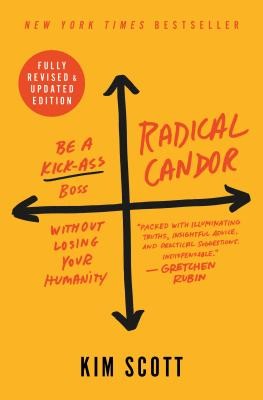
Radical Candor: Be a Kick-Ass Boss Without Losing Your Humanity

by Kim Scott

View on Amazon →

"Radical Candor is not brutal honesty. It's caring personally while challenging directly."

Scott introduces a two-dimensional framework for feedback built on 'caring personally' and 'challenging directly.' The book maps four quadrants of management behavior—Radical Candor, Ruinous Empathy, Obnoxious Aggression, and Manipulative Insincerity—and provides practical guidance for building a culture of honest, compassionate feedback.

Radical Candor addresses the single most common failure mode in leadership: the inability to give honest feedback. Scott's framework, developed through her experience at Google and Apple, gives managers a memorable mental model and concrete techniques for having difficult conversations without destroying relationships—a skill most leadership books acknowledge but few teach this effectively.

  • Care personally and challenge directly at the same time; most managers err toward Ruinous Empathy by being kind but not honest.
  • Solicit feedback before giving it—asking for criticism of your own work builds the trust needed to offer it to others.
  • Praise should be specific and sincere; vague positive feedback is nearly as damaging as no feedback at all.
  • Create a culture of guidance by making feedback a daily habit, not a quarterly event.
  • The Silicon Valley-centric examples may not translate well to industries or cultures where direct feedback is less socially acceptable.
  • Some critics argue the framework oversimplifies the nuances of workplace communication into a neat 2x2 matrix.
  • The book's advice on challenging directly can be misinterpreted as license for bluntness without sufficient emphasis on context and power dynamics.

"Kim Scott's insights—based on her experience, keen observational intelligence and analysis—will help you be a better leader and create a more effective organization."

Sheryl Sandberg, Author of Lean In

"If you manage people—whether it be 1 person or a 1,000—you need Radical Candor. Now."

Daniel Pink, Author of Drive

"With Radical Candor, Kim has bottled some of Google's magic and shared it with the world."

Shona Brown, Former SVP Business Operations, Google
09

Drive: The Surprising Truth About What Motivates Us

by Daniel H. Pink

View on Amazon →

"The secret to high performance and satisfaction—at work, at school, and at home—is the deeply human need to direct our own lives, to learn and create new things, and to do better by ourselves and our world."

Pink synthesizes four decades of research on human motivation to argue that the traditional carrot-and-stick approach is fundamentally flawed for creative and cognitive work. He presents a new operating system for motivation built on three pillars: autonomy (the desire to direct our own lives), mastery (the urge to improve at something that matters), and purpose (the yearning to serve something larger than ourselves).

Drive is essential because motivation is the core challenge of leadership—yet most organizations still rely on extrinsic incentives that research shows are counterproductive for complex work. Pink's autonomy-mastery-purpose framework gives leaders a science-based alternative to command-and-control management, making it foundational reading for anyone who needs to get the best out of knowledge workers.

  • Extrinsic rewards (bonuses, incentives) can actually diminish performance on creative and complex tasks—the opposite of what most managers assume.
  • Autonomy over task, time, technique, and team is the most powerful motivator for knowledge workers.
  • Mastery requires deliberate practice and a growth mindset; leaders should create conditions where people can pursue mastery of their craft.
  • Purpose—connecting individual work to a cause larger than oneself—transforms engagement from compliance to commitment.
  • Critics note that much of the research Pink cites is from psychology and behavioral science, and the application to real organizational settings is sometimes a stretch.
  • The book's dismissal of extrinsic motivation may be overdrawn; compensation and incentives still matter significantly, especially for non-creative work.
  • Some reviewers argue there is little in Drive that isn't covered in a standard introductory course in social psychology, making it more of a synthesis than original contribution.

"Daniel Pink is a genius at reframing the world around us in ways that are both unexpected and intuitive."

Malcolm Gladwell, Author of Outliers

"Pink's ideas on autonomy and intrinsic motivation are essential reading for anyone building a creative organization."

Tom Kelley, General Manager, IDEO
10

Turn the Ship Around!: A True Story of Turning Followers into Leaders

by L. David Marquet

View on Amazon →

"Don't move information to authority, move authority to the information."

Marquet recounts how he transformed the USS Santa Fe from the worst-performing submarine in the U.S. Navy fleet to the best by replacing the traditional leader-follower model with a leader-leader approach. By pushing authority to the information rather than pulling information to authority, he created an organization where every crew member thought and acted like a leader.

Turn the Ship Around! is the most compelling real-world case study of distributed leadership ever written. Marquet's intent-based leadership model—where subordinates say 'I intend to...' rather than asking permission—provides a concrete, proven alternative to command-and-control hierarchies that leaders in any industry can implement immediately.

  • Replace 'permission to...' with 'I intend to...'—this shifts psychological ownership from the leader to the person doing the work.
  • Give control to people closest to the information; they are better positioned to make timely, accurate decisions.
  • Competence and clarity must precede empowerment; people need both technical knowledge and organizational purpose to lead effectively.
  • Resist the urge to provide solutions—instead, create mechanisms that develop thinking and initiative at every level.
  • The military context—with its clear chain of command, shared mission, and high-stakes consequences—makes the leadership lessons harder to apply in ambiguous corporate settings.
  • The book focuses on a single, extraordinary turnaround story, making it difficult to assess how generalizable the leader-leader model truly is.
  • Some critics note that Marquet had significant positional authority to drive change; leaders without such authority may struggle to replicate his approach.

"Marquet's ideas and lessons are invaluable to anyone who wants to build an organization that will outlive them."

Simon Sinek, Author of Start with Why

"The Santa Fe is the most empowering organization I've ever seen."

Stephen R. Covey, Author of The 7 Habits of Highly Effective People

"The best how-to manual anywhere for managers on delegating, training, and driving flawless execution."

Fortune Magazine, Fortune
Back to all lists