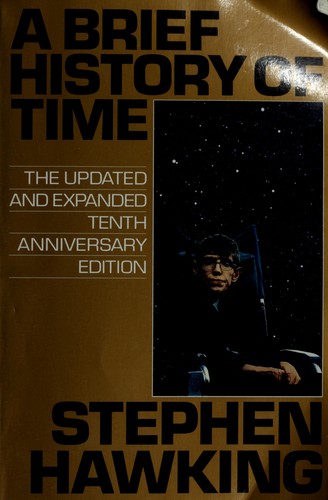
A Brief History of Time
View on Amazon →"If we do discover a theory of everything, it should in the long run be understandable by everyone, not just a few scientists, because it is concerned with the ultimate questions of life."
Stephen Hawking's groundbreaking exploration of black holes, the Big Bang, and the nature of time itself. This landmark book makes modern cosmology accessible to general readers without sacrificing scientific rigor. With lucid explanations and memorable analogies, Hawking addresses the universe's biggest mysteries.
Essential foundation for understanding modern cosmology and black holes. Hawking's elegant writing style demonstrates how complex physics can be explained to lay audiences. This book revolutionized popular science communication and has sold over 25 million copies worldwide.
- Black holes are not completely black—they emit radiation and eventually evaporate
- Time and space are interwoven and relative, not absolute concepts
- The universe likely had no beginning and no boundary in space-time
- The arrow of time is linked to entropy and thermodynamics
- Some technical explanations may still be challenging for non-scientists
- Published in 1988, some cosmological data is now outdated
- Lacks mathematical equations that some readers might find helpful
"Hawking's natural teacher's gifts—easy, good-natured humor and an ability to illustrate highly complex propositions with analogies plucked from daily life."
The New York Times, Major Publication"His is a brain of extraordinary power that can tackle the deepest mysteries of the cosmos."
The New York Review of Books, Major Publication"Masterful exposition of the current state of theoretical physics."
The Wall Street Journal, Major Publication